
5 Signs Your Business Needs Custom Software
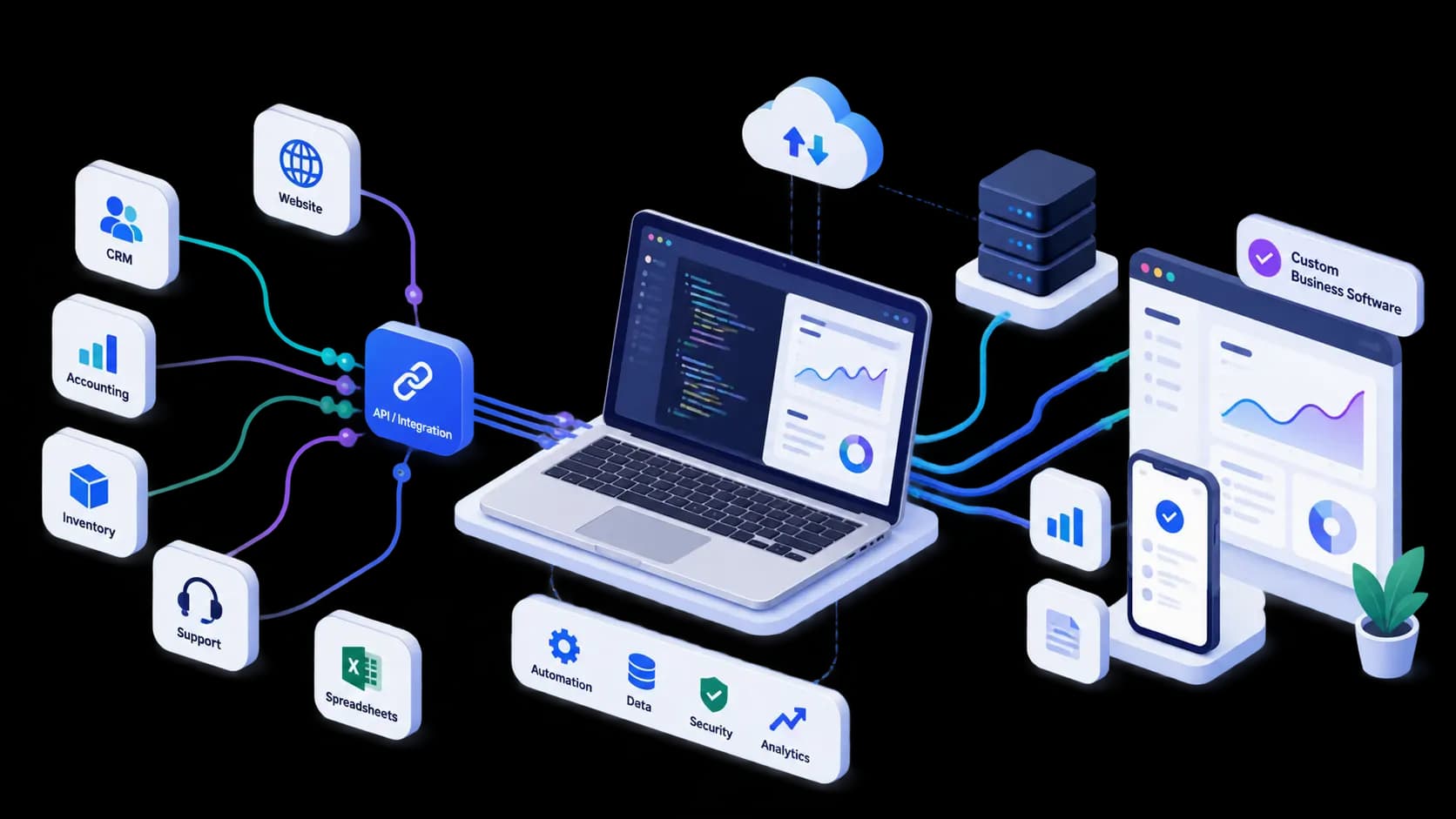
As businesses grow, spreadsheets, disconnected tools, and manual processes can start holding them back. Here are five signs that custom software may be the right next step for your business.
5 Signs Your Business Needs Custom Software
Running a business with spreadsheets, disconnected tools, and manual processes may work in the beginning.
But as the business grows, those same tools can start slowing everything down.
Your team may be entering the same information multiple times, switching between different platforms, or creating manual workarounds just to complete a simple task.
At some point, the question is no longer:
"Can we manage this with the tools we already have?"
It becomes:
"How much is our business losing because our software doesn't work the way we do?"
Custom software can help solve this problem by being built around your actual business processes instead of forcing your team to adapt to someone else's system.
Here are five signs that your business may be ready for it.
1. Your Team Is Doing Too Much Work Manually
Manual work is not always a problem.
The problem starts when your employees spend a significant part of their day doing repetitive tasks that software could handle.
For example:
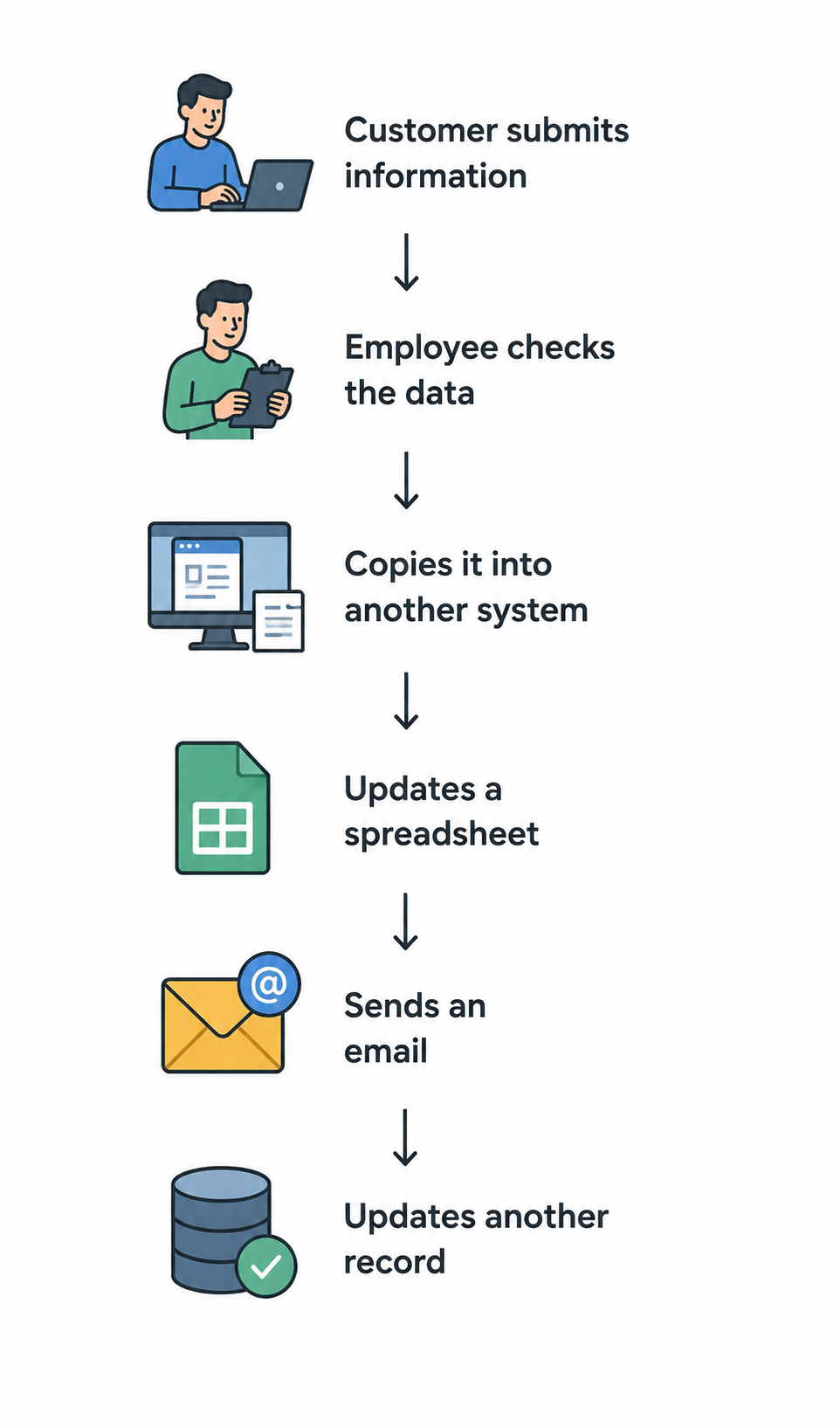
None of these steps may seem complicated individually. But when they happen hundreds or thousands of times, they consume a lot of time.
Custom software can connect these processes together:
Customer submits information
        ↓
      SYSTEM
        ↓
Validate → Store → Notify → Update → Report
Instead of employees moving information between systems, the software handles repetitive work automatically.
The result is less manual work, fewer errors, and more time for tasks that actually require human judgment.
2. Your Existing Tools Don't Talk to Each Other
A growing business often ends up using multiple tools.
You might have a CRM for sales, accounting software for finances, a separate inventory system, a website, a customer support platform, and several spreadsheets.
Each tool may work perfectly on its own. The problem starts when these systems don't share information properly.
Your sales team may have customer information in one system while your operations team maintains another version somewhere else. This can lead to duplicate data, inconsistent information, and unnecessary manual work.
Custom software can act as a central layer that connects the systems you already use:
              CRM
               ↓
Website → Central System ← Accounting
               ↑
          Inventory
               ↑
          Support Tool
The goal isn't always to replace every tool. Sometimes the better solution is to connect the tools you already use and create one reliable flow of information.
3. Your Business Process Is Too Unique for Standard Software
Most SaaS products are designed to solve common problems for a large number of businesses. That's their strength. But it can also become their limitation.
Imagine your company has a process like this:
New Order → Quality Check → Manager Approval → Custom Pricing → Production → Delivery → Customer Confirmation
A standard software product may support some of these steps. But your approval rules, pricing model, workflow, or reporting requirements may be completely different.
You may eventually find yourself creating workarounds just to make the software fit your business:
Standard Software
       ↓
Doesn't fit exactly
       ↓
Workarounds
       ↓
Manual Steps
       ↓
More Complexity
This is one of the strongest signs that custom software may make sense. Instead of changing your business process to fit the software, you can build the software around the process.
4. Your Business Is Growing Faster Than Your Systems
A process that works for 20 employees may not work for 200. A system that handles 1,000 customers may struggle when you have 100,000.
Growth exposes weaknesses that were not visible earlier. You may start seeing:
- Slower internal processes
- More data entry errors
- Increasing support requests
- Performance problems
- Difficulty generating reports
- Too many spreadsheets and disconnected tools
- Employees creating their own shadow IT workarounds
At this stage, adding another tool may only create another layer of complexity. Sometimes the better approach is to rethink the underlying system:
Small Business → Simple Tools → Business Growth → More Complexity → Existing Systems Become Limiting → Custom Business Software
Good custom software should not only solve today's problems. It should give your business room to grow.
5. Your Software Is Limiting What Your Business Can Do
This may be the biggest sign. Technology should support your business strategy. It shouldn't decide what your business is allowed to do.
Suppose you want to launch a new service, create a customer portal, automate a workflow, introduce personalized pricing, or integrate AI into your operations. But your existing software makes every change difficult.
You may constantly hear:
"The system doesn't support that."
That's a problem. Your technology should help you move faster, not become a barrier to new ideas. Custom software gives you more control over how your digital systems evolve:
Business Idea → Technology → Implementation → Launch → Feedback → Improvement
Instead of waiting for a software vendor to introduce a feature, your system can evolve with your business.
Does Every Business Need Custom Software?
No. Custom software is not automatically better than SaaS. If an existing product solves your problem efficiently, there may be no reason to build something from scratch.
A simple way to think about it is:
Does existing software solve the problem?
                ↓
          ┌─────┴─────┐
         YES           NO
          ↓             ↓
       Use SaaS      Evaluate Custom Software
Custom development becomes more attractive when your business process is unique, existing tools create significant inefficiency, or your software has become strategically important to the business.
Build Custom Software When the Business Case Makes Sense
The goal isn't to build software simply because you can. The goal is to solve a real business problem.
Before starting a custom software project, ask yourself:
- How much time are we losing today?
- How many manual processes can be automated?
- Are our systems sharing data properly?
- Is our current software limiting growth?
- Does our business have workflows that standard tools cannot handle?
- Will solving this problem create measurable business value?
If the answers point toward a real operational problem, custom software can become a business investment rather than just another technology expense.
Don't Build Everything From Scratch
Custom software doesn't necessarily mean replacing your entire technology stack. A modern solution can combine existing platforms with custom components.
For example:
              Your Business Platform
                       ↓
        ┌──────────────┼──────────────┐
        ↓              ↓              ↓
    Custom App        CRM          Payments
        ↓              ↓              ↓
        └──────────────┼──────────────┘
                       ↓
                      APIs
                       ↓
                Central Data Layer
                       ↓
             Automation & Analytics
You can keep the systems that already work and build custom technology around the areas where your business needs more control. This can create a more practical and cost-effective solution.
The Bigger Picture
Custom software isn't about having something that nobody else has. It's about having technology that fits your business.
When your software understands your workflows, connects your systems, reduces repetitive work, and gives your team better visibility, technology becomes part of your competitive advantage.
The right question isn't:
"Do we need custom software?"
The better question is:
"Is our current software helping our business grow, or is it holding us back?"
That answer can tell you when it's time to build something better.
Final Thoughts
Businesses naturally evolve. Processes change. Teams grow. Customers expect more. Operations become more complex.
The software that worked perfectly a few years ago may no longer be the right fit today. If your team is constantly creating workarounds, entering data manually, switching between disconnected systems, or compromising business processes because of software limitations, it may be time to consider a custom solution.
The right technology should adapt to your business. Not the other way around.
Build Software Around Your Business With Axione Solutions
At Axione Solutions, we help businesses turn complex workflows into reliable digital systems.
From custom web applications and business platforms to API integrations, automation, and scalable software solutions, we focus on building technology around the way your business actually works.
Have a process that your current software can't handle?
Let's build a better solution.