
AI Automation and Agentic AI for Modern Businesses
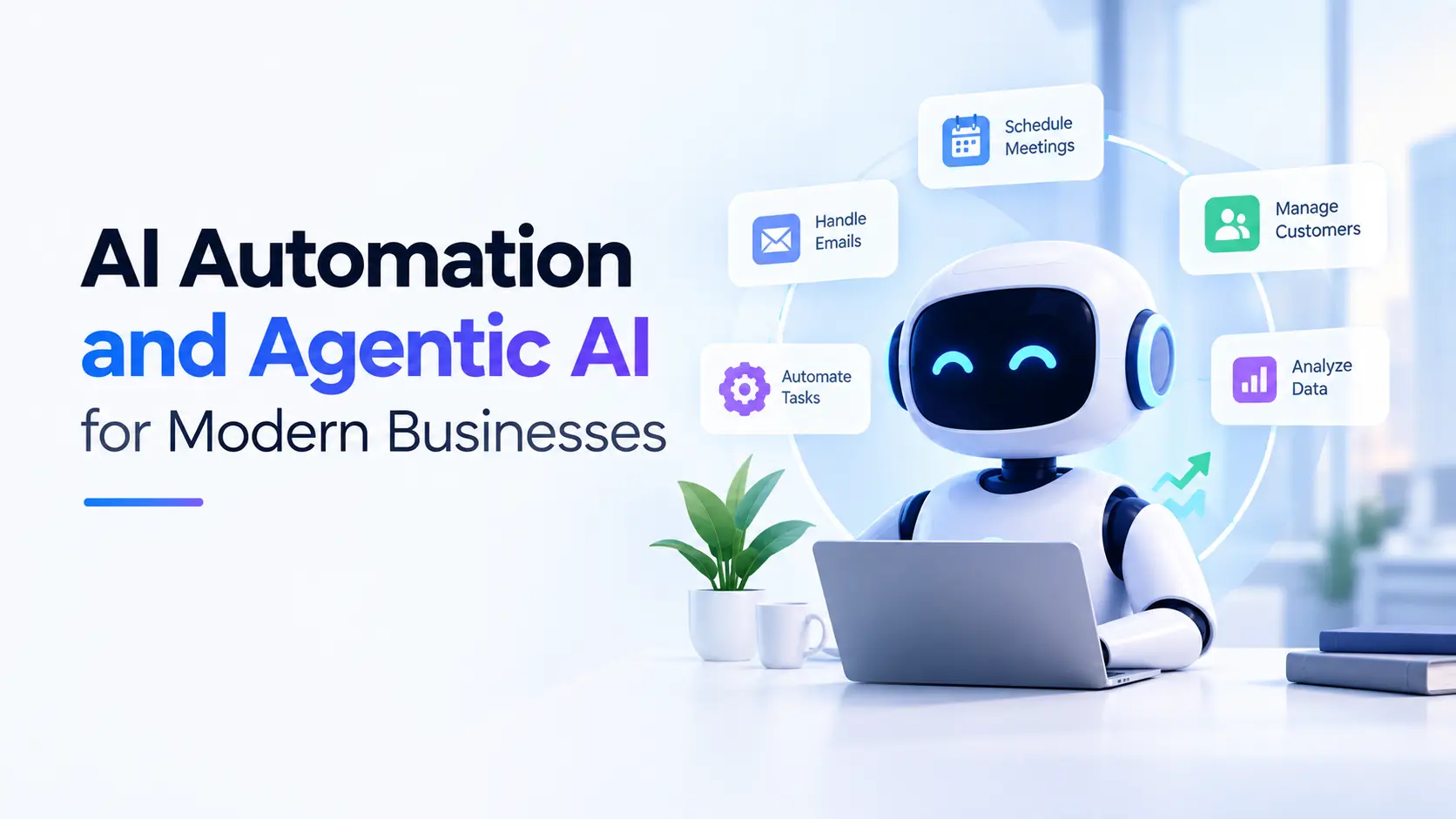
Discover how AI automation and agentic AI empower decision-makers to scale operations, boost resilience, and achieve smarter, faster business outcomes.
Introduction
In today’s competitive landscape, AI is no longer a luxury; it’s a strategic necessity. AI automation and agentic AI concepts are transforming how decision-makers design processes, allocate resources, and respond to market shifts. This article outlines practical approaches for Indian businesses to adopt AI-powered automation while preserving human oversight and strategic control.
What is AI Automation and Agentic AI?
AI automation refers to systems that perform repetitive, rule-based, or data-heavy tasks with minimal human intervention. It improves speed, accuracy, and consistency across operations, from customer support to data entry and analytics.
Agentic AI takes automation a step further by enabling AI agents that act with a degree of autonomy to achieve defined goals. These agents can plan actions, monitor outcomes, adapt to changing inputs, and collaborate with humans. The key distinction is that agentic AI is not merely following scripts; it reasons, selects actions, and communicates results to stakeholders.
Why Agentic AI Matters for Businesses
- Scalability: Automated processes handle surge volumes without proportionate increases in headcount.
- Agility: Agents can adjust plans in real-time, enabling faster pivots during uncertain times.
- Decision Quality: AI-suggested actions come with data-backed rationale, supporting better governance.
- Customer Experience: Faster, more consistent responses improve satisfaction and loyalty.
However, a successful deployment requires clear boundaries, governance, and a human-in-the-loop when needed. The goal is augmenting human decision-making, not replacing it.
Practical Framework for Implementation
1. Start with High-Impact, Low-Risk Processes
Identify repetitive, data-driven tasks that are rule-based and have measurable outputs. Examples include invoice processing, report generation, and customer inquiry triage. Begin with a pilot that has clear success criteria and minimal disruption.
2. Define Clear Goals and Boundaries
For each AI solution, articulate the objective (e.g., reduce cycle time by 30%), the allowed actions, and escalation rules. Establish service level agreements (SLAs) for exceptions and human review thresholds.
3. Build an Incremental Autonomy Ladder
Stage AI capabilities from assistive to autonomous:
- Assistive: AI suggests actions.
- Collaborative: AI proposes actions and awaits human approval.
- Autonomous: AI executes actions within predefined constraints.
This ladder helps teams gain confidence and ensures governance at every step.
4. Invest in Data Quality and Observability
Automation is only as good as the data it consumes. Implement data governance, lineage tracking, and monitoring dashboards to detect drift, anomalies, and performance gaps quickly.
5. Integrate with Human Workflows
Automation should complement, not disrupt, existing processes. Design interfaces that surface AI insights alongside historical data, dashboards, and collaborative tools familiar to your teams.
6. Prioritise Explainability and Trust
Provide rationale for AI recommendations, especially in operations and customer-facing contexts. Transparency helps with adoption, compliance, and risk management.
7. Security, Privacy, and Compliance
Adopt robust access controls, audit trails, and data minimisation practices. Align with local regulations and industry standards to protect customer data and business intelligence.
Case Illustrations: Practical Scenarios
- Scenario A: Automated invoice reconciliation for a mid-sized supplier network. An AI agent matches invoices with purchase orders, flags discrepancies, and routes exceptions to finance teams with suggested corrections.
- Scenario B: Customer support triage. An AI agent reads tickets, assigns priority levels, suggests resolution steps, and escalates only when confidence drops below a threshold.
- Scenario C: Market intelligence synthesis. An AI system aggregates public data, summarizes trends, and proposes strategic actions to the leadership team.
In each case, the emphasis is on measurable outcomes, clear boundaries, and continuous learning. The best practices rely on a feedback loop: human review when necessary, performance metrics, and periodic recalibration of models and rules.
Challenges and Governance
AI automation introduces governance challenges such as bias, data privacy, and responsibility for automated decisions. To address these:
- Establish an accountability framework that designates owners for each automated process.
- Implement bias checks and fairness audits for data-driven decisions.
- Maintain human-in-the-loop for high-stakes actions or opaque outcomes.
- Document decision rationales and keep auditable logs for compliance.
Costs and implementation timelines vary by industry and complexity. A pragmatic approach is to run parallel tracking dashboards during the initial rollout, comparing AI-recommended actions with traditional outcomes to demonstrate value before full deployment.
Quick Wins and Takeaways
- Begin with a single, well-scoped process and a strong executive sponsor.
- Choose vendor or in-house solutions that offer clear governance controls and explainability features.
- Maintain human oversight for critical decisions, especially those impacting customers or regulatory requirements.
- Build a culture of continuous learning—regularly review outcomes, retrain models, and retire outdated rules.
- Measure not only efficiency gains but also quality, customer satisfaction, and risk exposure.
Conclusion
AI automation and agentic AI hold substantial promise for Indian businesses seeking to scale operations, enhance resilience, and accelerate decision-making. By starting with high-impact, well-governed pilots and gradually increasing autonomy with proper oversight, organisations can realise meaningful improvements while preserving human judgment and strategic direction. Embracing these technologies thoughtfully enables sustainable growth in a dynamic market.
Practical Takeaways
- Start small, with a defined objective and success metrics.
- Build in governance, explainability, and human oversight from day one.
- Use dashboards to monitor performance, drift, and risk continuously.
- Align automation initiatives with core business goals and customer experience.
- Invest in data quality and change management to maximise ROI.