
AI Automation at Work: Agentic AI for Smarter Teams
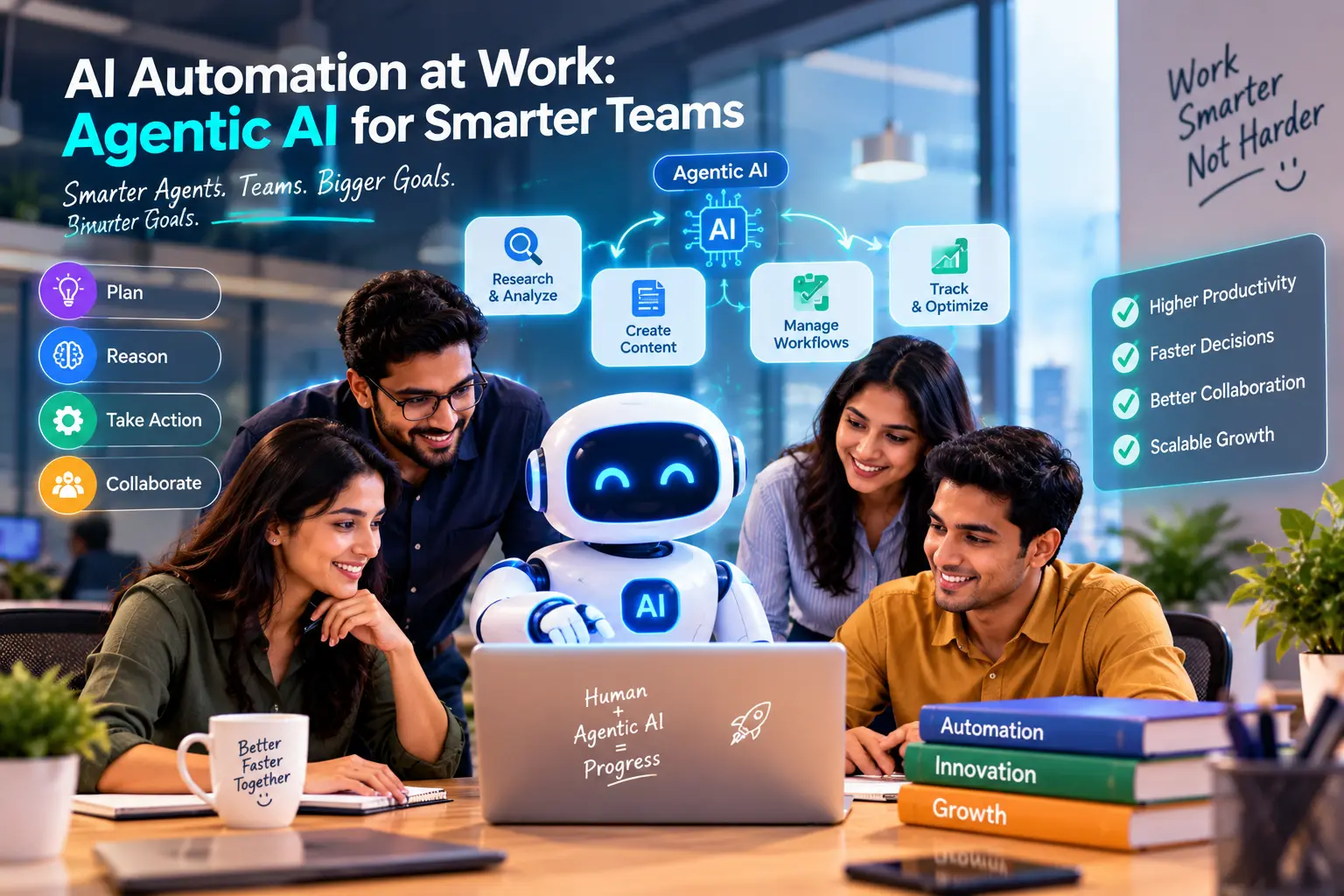
Discover practical AI automation strategies and agentic AI concepts to boost decision speed, collaboration, and operational efficiency across teams.
Introduction
In today’s fast-paced business landscape, AI automation is no longer a luxury; it is a strategic necessity. For Indian businesses aiming to scale, agentic AI—AI systems that act with a degree of autonomy to achieve predefined goals—offers a powerful lever to improve decision speed and operational efficiency. This post provides practical, field-tested approaches for implementing AI automation and agentic AI in daily business operations.
Understanding AI Automation and Agentic AI
Agentic AI refers to systems that can take initiative within boundaries set by human stakeholders. They monitor workflows, propose optimisations, and execute routine tasks, freeing human teams to focus on high-impact work. AI automation, on the other hand, covers automated data processing, decision support, and process orchestration powered by machine learning, RPA, and analytics.
Start with High-Impact, Repetitive Tasks
The fastest path to ROI is to automate repetitive, rule-based tasks with clear outcomes. Examples include data entry, invoice processing, appointment scheduling, and report generation. Begin by mapping one end-to-end process, identify pain points, and define success metrics such as time saved, error reduction, or throughput.
Practical steps:
- Document current steps and decision points.
- Identify tasks that are highly repetitive or error-prone.
- Choose tools that align with your tech stack (RPA, workflow automation, or AI-powered analytics).
- Set measurable targets (e.g., reduce processing time by 40%).
Integrate Agentic AI for Decision Support
Agentic AI should augment human decision-makers, not replace them. For Indian SMEs, this means systems that surface insights, propose courses of action, and automatically execute safe actions within governance rules. Start with decision support, then gradually add autonomy for routine, low-risk tasks.
Practical steps:
- Define decision rights and escalation paths.
- Build dashboards that reveal bottlenecks and next best actions.
- Implement guardrails: thresholds, approvals, and audit trails.
- Pilot in a single department before scaling.
Data Readiness: The Foundation
AI systems are only as good as the data behind them. Establish data governance practices: data quality checks, consistent data definitions, and accessible data pipelines. Invest in metadata management and documented data lineage to build trust with stakeholders.
Practical steps:
- Inventory data sources and owners.
- Create a master data schema for key entities.
- Implement data quality checks and alerting.
- Use synthetic data sparingly to test new models.
Build a Layered Architecture
A practical architecture stacks data capture, processing, decision logic, and automation. A typical layering: data ingestion and cleansing -> ML/analytic models -> decision orchestration -> automated actions. This separation helps with governance, monitoring, and scalability.
Practical steps:
- Use a central orchestration engine to coordinate tasks.
- Separate model development from production workflows.
- Employ logging and observability across the stack.
- Start with a minimal viable automation and iterate.
Governance, Compliance, and Security
Security and compliance are critical, especially for financial and customer data. Implement role-based access, audit logs, data encryption, and model risk management. In India’s regulatory landscape, ensure processes comply with applicable data protection and financial regulations.
Practical steps:
- Define access controls by role and data sensitivity.
- Maintain an auditable trail of automated actions.
- Regularly review models for bias and accuracy.
- Document incident response plans.
Change Management and People First
Automation technologies succeed when people embrace them. Communicate clear goals, involve teams early, and provide training. Highlight how automation reduces busywork and enables more meaningful work. Create champions in each department who can mentor others.
Practical steps:
- Run a kickoff workshop with leadership and frontline staff.
- Produce simple, role-based training materials.
- Establish feedback loops to improve automation features.
- Celebrate quick wins to build momentum.
Practical Takeaways
- Start with measurable, high-impact tasks to demonstrate value quickly.
- Use agentic AI to augment decision-makers, not replace them.
- Invest in data readiness and governance from day one.
- Build a layered, scalable architecture with robust monitoring.
- Prioritise people, governance, and change management alongside technology.
Conclusion
AI automation and agentic AI offer a practical path for Indian businesses to boost efficiency, accelerate decision-making, and improve team collaboration. By starting small, focusing on governance, and empowering people, you can scale automation responsibly and sustainably across your organisation.