
AI Automation for Agentic AI: Practical Guide
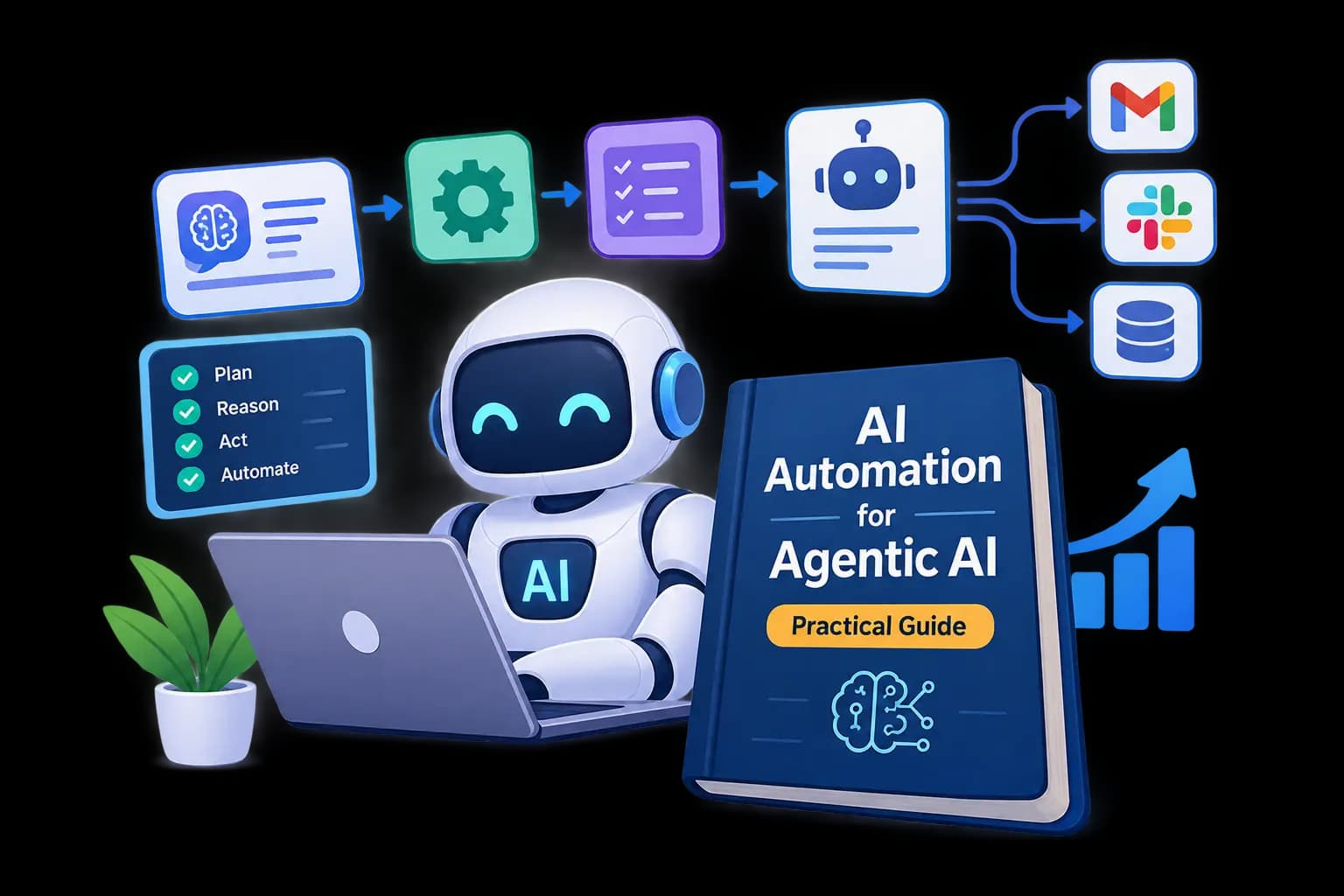
Discover practical strategies to implement AI automation and agentic AI in your business, boosting decision speed, consistency, and scalable outcomes.
AI Automation for Agentic AI: Practical Guide
In today’s competitive Indian market, business leaders are looking beyond basic automation. They seek agentic AI that can act autonomously within defined boundaries, learning from feedback, and driving outcomes without micromanagement. This guide offers practical steps to design, implement, and govern AI automation that behaves like a proactive business partner.
What is agentic AI and why it matters
Agentic AI refers to systems that can set goals, plan actions, and execute tasks while adapting to changing circumstances. Unlike static automation, agentic AI reasons about trade-offs, negotiates with other systems, and improves over time through feedback loops. For decision makers, this means faster cycles, fewer manual handoffs, and more scalable operations.
However, agentic AI is not a magic wand. It requires clear governance, well-defined objectives, and robust safety controls to prevent drift or unintended consequences. When deployed thoughtfully, it becomes a force multiplier for product development, customer experience, and operational efficiency.
Start with a clear business objective
Before touching technology, crystallize the outcome you want. Whether it is reducing order processing time, improving lead qualification, or optimizing inventory, you must translate the goal into measurable metrics:
- Define a primary KPI (e.g., AHT, reject rate, conversion rate).
- Set a target and a time horizon.
- Identify the decision points where AI will act autonomously and where human oversight remains essential.
A precise objective helps you design the agent’s scope, choose the right models, and allocate governance resources.
Map the decision workflow
Create a workflow diagram that captures data inputs, decision nodes, actions, and feedback loops. Include:
- Data sources: CRM, ERP, transactional logs, customer support chats, supply chain feeds.
- Decision criteria: thresholds, confidence scores, and business rules.
- Actions: sending alerts, updating records, initiating approvals, triggering fulfillment.
- Feedback loops: how results feed back into the model and rule updates.
An explicit workflow reduces ambiguity and makes it easier to test agentic behavior in a controlled manner.
Data quality and governance foundations
Agentic AI is only as good as the data it consumes. In an Indian business environment, data heterogeneity is common across regions and channels. Build a governance framework focusing on:
- Data quality: completeness, consistency, timeliness, and accuracy.
- Data provenance: where data comes from and how it’s transformed.
- Privacy and compliance: align with local regulations and consent requirements.
- Bias detection: monitor outputs for unintended biases across customer segments.
Invest in data cataloging and lineage tooling so you can trace decisions back to data sources when auditing AI behavior.
Choose the right architectural approach
Agentic AI can be composed of a mix of components:
- Planning and reasoning module: generates action plans and timelines.
- Perception module: interprets data streams and user intents.
- Action module: executes tasks through APIs or workflow orchestration.
- Learning module: updates models based on outcomes and feedback.
Consider a modular architecture with clear boundaries and well-defined interfaces. This makes it easier to upgrade components, run experiments, and rollback if needed.
Safety, control, and human-in-the-loop
Autonomy must be bounded. Establish:
- Guardrails: hard limits on actions (e.g., no financial transfers without human approval).
- Confidence thresholds: only act when the model is above a predefined certainty level.
- Audit trails: maintain logs of decisions, data inputs, and outcomes for accountability.
- Human-in-the-loop (HITL): keep critical decisions within human oversight to handle exceptions or ethical concerns.
Regularly test the system with edge cases to ensure reliability under real-world conditions.
Practical design patterns for your first deployment
- Task automation with adaptive routing
- Use agentic AI to triage incoming requests, route to the right team, and adjust routing based on queue lengths and expertise.
- Benefit: faster response times and higher first-contact resolution.
- Autonomous data enrichment for sales and marketing
- The agent pulls relevant data, enriches records, and nudges human sellers with recommended actions.
- Benefit: higher win rates and better lead quality without increasing headcount.
- Operations optimization with autonomous scheduling
- The agent schedules production or service windows considering constraints, demand signals, and supplier availability.
- Benefit: improved utilization and reduced downtime.
- Compliance-driven automation
- The agent monitors transactions for rule-compliance and flags anomalies for review.
- Benefit: risk reduction and audit readiness.
Metrics that matter when you deploy agentic AI
- Decision cycle time: time from data input to action.
- Auto-resolution rate: percentage of tasks completed without human intervention.
- Model confidence distribution: track how often the system acts with high confidence.
- Business impact: translation of automated actions into revenue, cost savings, or customer satisfaction.
- Safety and governance KPIs: incidents, drift, and rollback frequency.
Use dashboards that align with business units—sales, customer service, operations—and ensure executives have visibility into both outcomes and risks.
Change management and capability development
Agentic AI changes how teams operate. Invest in:
- Training: teach staff how to interpret AI recommendations and override actions when necessary.
- Collaboration rituals: align humans and machines through joint review sessions and feedback loops.
- Skill uplift: upskill employees to design better workflows and interpret model outputs.
A successful rollout blends technology with culture, ensuring teams trust and rely on agentic AI as a partner, not a threat.
Practical takeaways
- Start with a single, well-scoped objective to pilot agentic AI.
- Build a transparent data and governance framework to maintain quality and trust.
- Design modular components with clear interfaces for scalability.
- Implement safety rails and HITL for high-stakes decisions.
- Track business impact with actionable metrics and continuous improvement loops.
Final thoughts for Indian businesses
Agentic AI is a strategic enabler for mid-market and large enterprises alike. For Indian business owners and decision-makers, the payoff lies in faster decision-making, improved efficiency, and scalable customer experiences. Begin with a clear objective, invest in governance, and adopt pragmatic, modular designs that let you learn quickly and expand confidently.
Take action now
- Map a high-value business process to automate with agentic AI.
- Assemble a cross-functional pilot team spanning IT, operations, and business units.
- Define success criteria and a 90-day evaluation plan.
- Establish safety controls and a HITL protocol from day one.
This approach helps you realize tangible benefits while maintaining control and adaptability as technology advances.